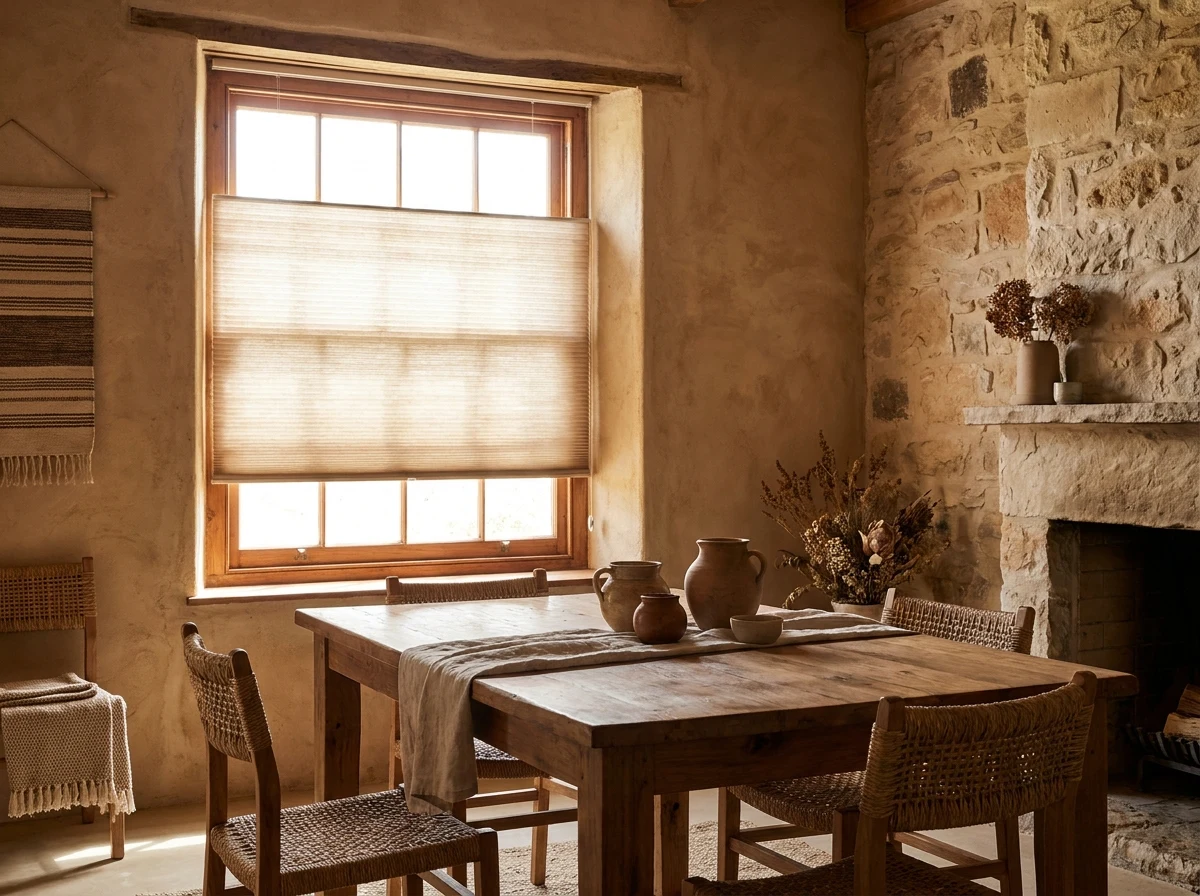
Cellular & honeycomb blinds for Durbanville’s big glass
Pleated fabric forming hexagonal air cells in profile — the best-insulating interior blind made, and a genuinely useful buffer against a valley that runs hot in summer and properly wet in winter.
A cellular blind softens a big Durbanville dining window without losing daylight.
Trapped air is insulation. That's the whole idea behind a cellular blind, and it's a genuinely useful one in a valley where a north or west-facing room can run hot through a long summer afternoon and then feel the chill of a proper wet Cape winter a few months later. Single cells suit milder rooms, double cells do the serious thermal work — cooler summer rooms, warmer winter ones, and a bit quieter too, since the cells absorb sound as well as heat.
Options worth knowing about
Light-filtering or blockout cell fabrics — blockout cells give a bedroom genuine darkness with the thermal bonus built in.
Top-down / bottom-up operation — privacy at the bottom, light and sky at the top. A strong option for street-facing rooms and any window a passer-by or neighbour can see straight into.
Cordless and motorised operation — and the slimmest stack of any blind when raised, which matters on a tall gable window.
Skylight and shaped-window versions — the cell structure holds its shape on an angle, useful for the gable ends common on Durbanville’s farmstead-style roofs.
Where it earns its keep in Durbanville
Energy-conscious renovations, bedrooms and nurseries that need dark-quiet-warm all at once, and any room where the family has noticed “that side of the house is always the hot one in summer and the cold one in winter” — a fair description of quite a few Durbanville homes built to face the afternoon sun and the view together.
The cost, plainly
Charged by the square metre of finished blind, fitted. A corded or cordless honeycomb lands in the R1,500–R2,800 region — single cell in a plain light-filtering fabric low down, double cell or a blockout-lined cell higher up, where the thermal work really happens. Motorised, the region becomes R3,000–R4,800, which is where a top-down bottom-up bedroom blind or a gable window out of arm’s reach ends up.
A minimum applies on small openings: components and fitting hours hardly change with the size of the glass. The regions are for planning a budget only — the free measure produces the actual figures, in writing, before production starts.