How to read the light on a wine-valley home — north, west, east and south — and choose shading that tames a 28°C February afternoon without giving up the view the window was built around. Free to read, written for this valley specifically.
Durbanville & the northern winelands~12–15 minute readNo sign-up to read
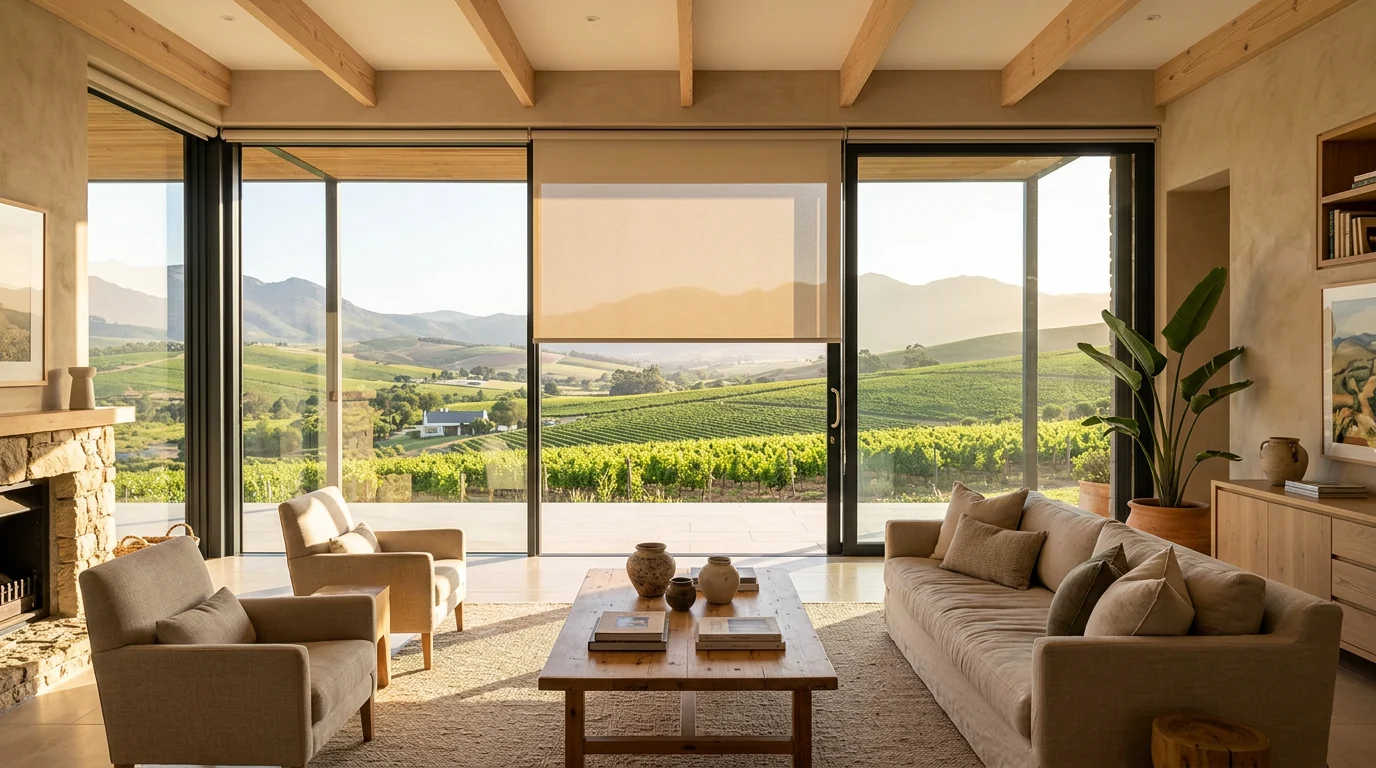
Late afternoon in a Durbanville lounge — the exact hour the west sun becomes the problem.
Everything below is in a single PDF if you would rather save it than scroll.
Durbanville shades differently to the rest of Cape Town, and it comes down to three things the valley can’t change: where its homes face, how hard its summer sun is, and how wet its winters get. Sitting in a shallow valley at 100–240 m and ringed by working vineyards, most Durbanville homes are turned deliberately toward the vines — which means they’re turned toward the sun too. Add a Mediterranean climate that runs dry and fierce in summer, then cool and damp in winter, and one blockout blind on every window is almost never the right answer. This guide walks the house elevation by elevation, names the product we’d specify and why, and — just as honestly — where the cheaper option is the right one.
The light here, by season
Why the four-o’clock sun, not the noon sun, is the one that ruins a Durbanville room.
At 34° south, the midday sun always sits in the northern sky, so north-facing rooms get light all day, every day. What changes is the angle. In high summer (late December) the noon sun climbs to roughly 80° — almost straight overhead — so a modest eave or overhang shades north glass at midday without any blind at all. In midwinter (June) that same noon sun drops to about 33°, low enough to pour deep into north rooms, which in winter is welcome free warmth you don’t want to block permanently.
The trouble is the west. Because the summer sun rises and sets well to the south of due east and west, it tracks around to the north-west and sits low in the sky from about 15:00, firing almost horizontally straight at west-facing glass at eye level — the hour a lounge becomes unusable and a TV washes out. An eave can’t stop a low, side-on sun; only something at the glass can. With February highs near 28°C and a Cape summer UV index that runs 11–13 (rated “extreme”), that afternoon load is heat, glare and fabric-fade all at once. That’s the problem this guide is really about.
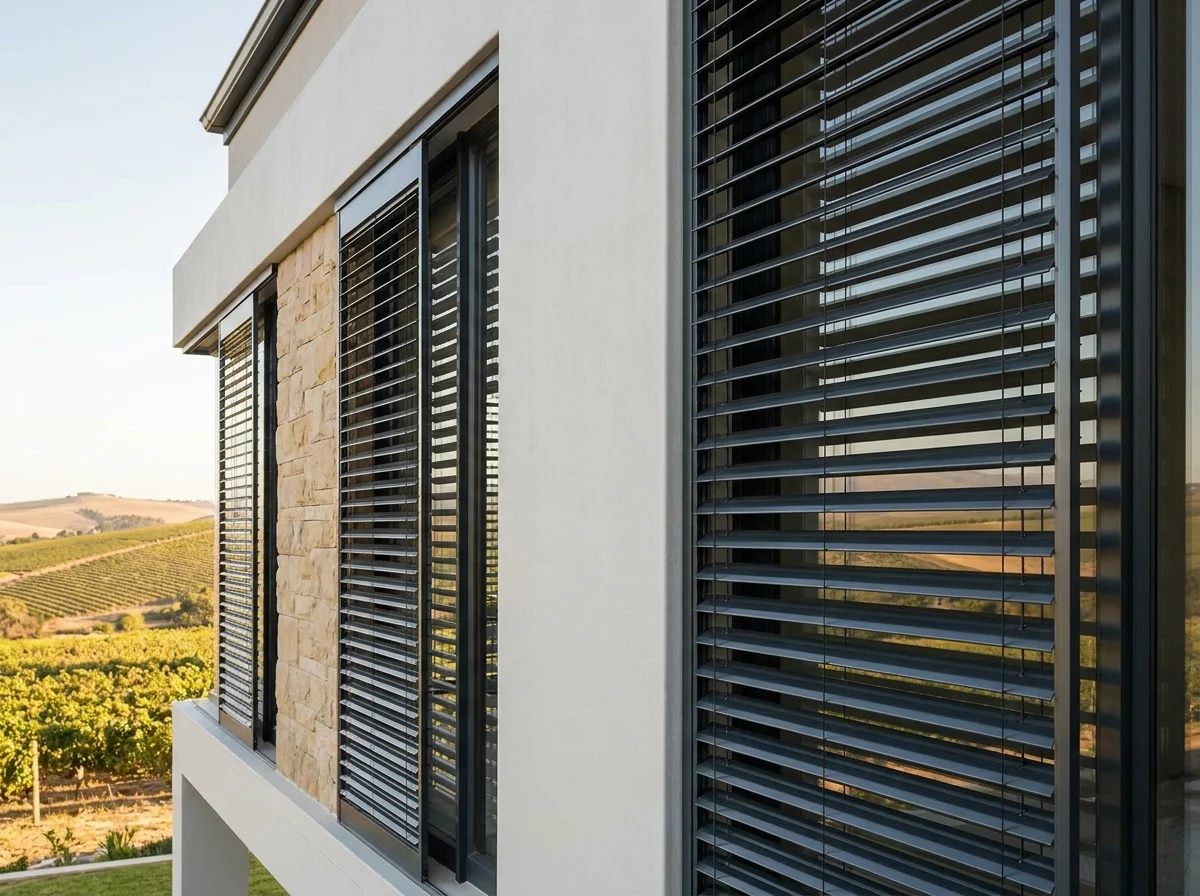
External venetians stop the west sun outside the pane — the slats tilt to hold the view while cutting the glare.
Elevation by elevation
Walk your own house in your head as you read — you’ll know which of these is your problem window.
North Sun all day
High summer sun (easy to shade), low winter sun (worth keeping). Sunscreen roller or an external device that adjusts beats permanent blockout — you want to manage this light, not kill it.
West The hard case
Low, brutal 15:00–19:00 summer sun straight at eye level. Heat and glare stopped outside the glass wins here; an interior blind is the fallback, not the ideal.
East Morning only
Bright, direct sunrise light in bedrooms and breakfast rooms, gone by mid-morning. Blockout or a day/night blind for the sleep-in; the heat load is mild, so interior is fine.
South Damp, not sunny
Almost no direct winter sun, least ventilation, most winter damp. The enemy here is condensation and mildew, so moisture-tolerant surfaces beat insulating fabric.
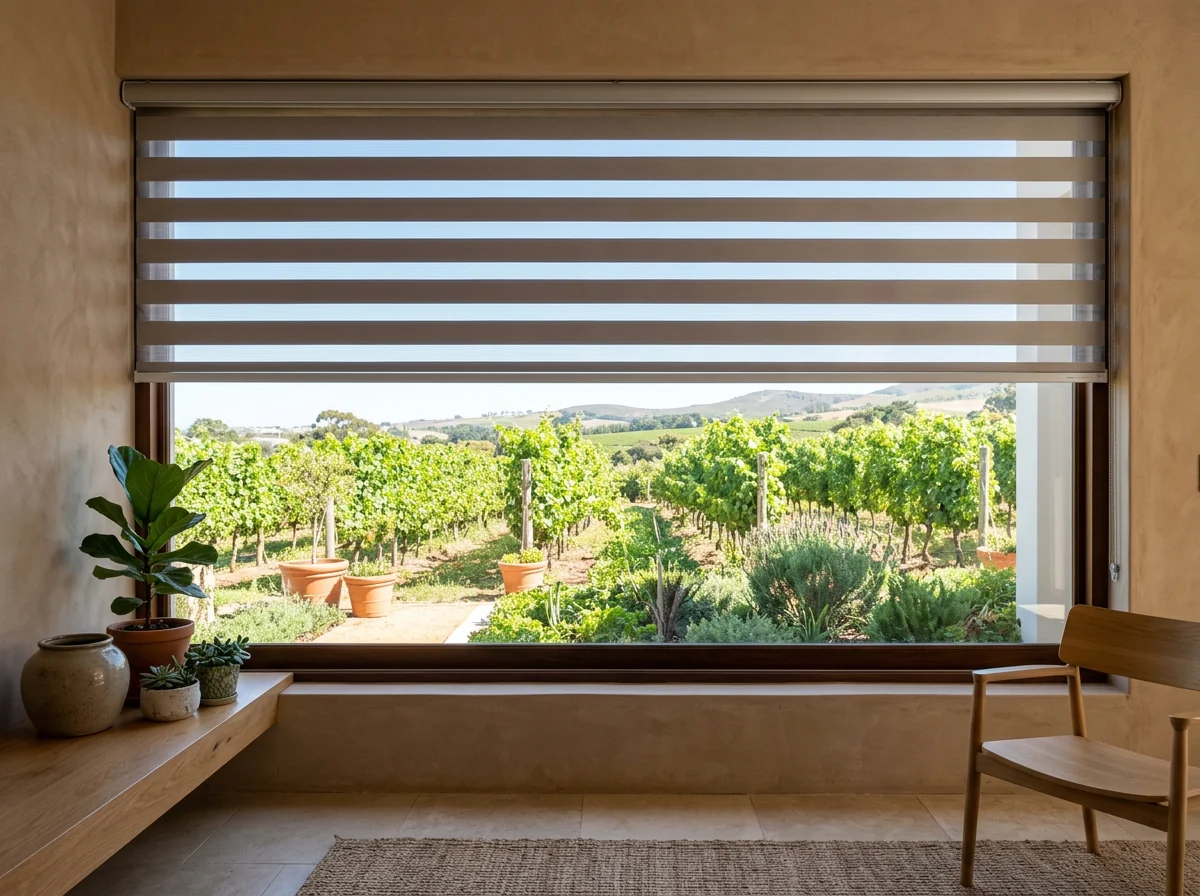
A day/night blind with its bands aligned — a filtered vineyard view by day, near-solid privacy from the road once you offset them at night.
What we’d specify, and the honest trade-off
Every card names when it wins in Durbanville — and when the cheaper choice is the right one instead. Tap “add to my list” on anything you want, and it carries down to the two options at the foot of the page with no retyping.
West & north-west glass · the afternoon-heat fix
External venetians over an interior blockout roller
On unobstructed west glass, stopping the sun outside the pane is the difference between a cool room and a warm one. External venetian slats bounce the low afternoon sun away before it becomes heat inside, and they tilt so you keep the vineyard view instead of sealing the room dark. An interior blockout roller only absorbs that heat after it’s through the glass — the pane still radiates warmth into the room.
The other way round: external venetians cost more, are a bigger install, and need a wind sensor for the south-easter. If that west window is already shaded by a deep eave or a neighbour’s wall, or budget leads, an interior sunscreen or blockout roller is the sensible, far cheaper call.
View-facing lounge & dining glass
Sunscreen roller over a blockout roller
The whole point of most Durbanville lounge glass is the vineyard view, so a mesh sunscreen fabric (3–5% openness) is usually right: it cuts glare and blocks most of that extreme summer UV while leaving the view intact. A blockout would trade the view for darkness you don’t need in a living room by day.
The honest catch: sunscreen gives daytime privacy but reverses after dark — once the lights are on inside, people can see in. If that window faces the road or a neighbour, pair it with a blockout (see day/night below) rather than relying on sunscreen alone.
Windows that need a view and night privacy
A day/night blind over two separate blinds
A day/night (double-roller) blind carries alternating sheer and solid bands on one tube: line them up for a filtered view by day, offset them for near-solid privacy from the road at night — one blind, both jobs, on the street-facing lounge or bedroom window that a single sunscreen can’t privacy-cover after dark.
The other way round: it costs more than a single roller. If a window has no night-privacy problem — it faces your own garden or the vines — a plain sunscreen roller does the daytime job for less, and a day/night is money you don’t need to spend.
Dry bedrooms wanting warmth + a proper sleep-in
Cellular / honeycomb where insulation is the goal
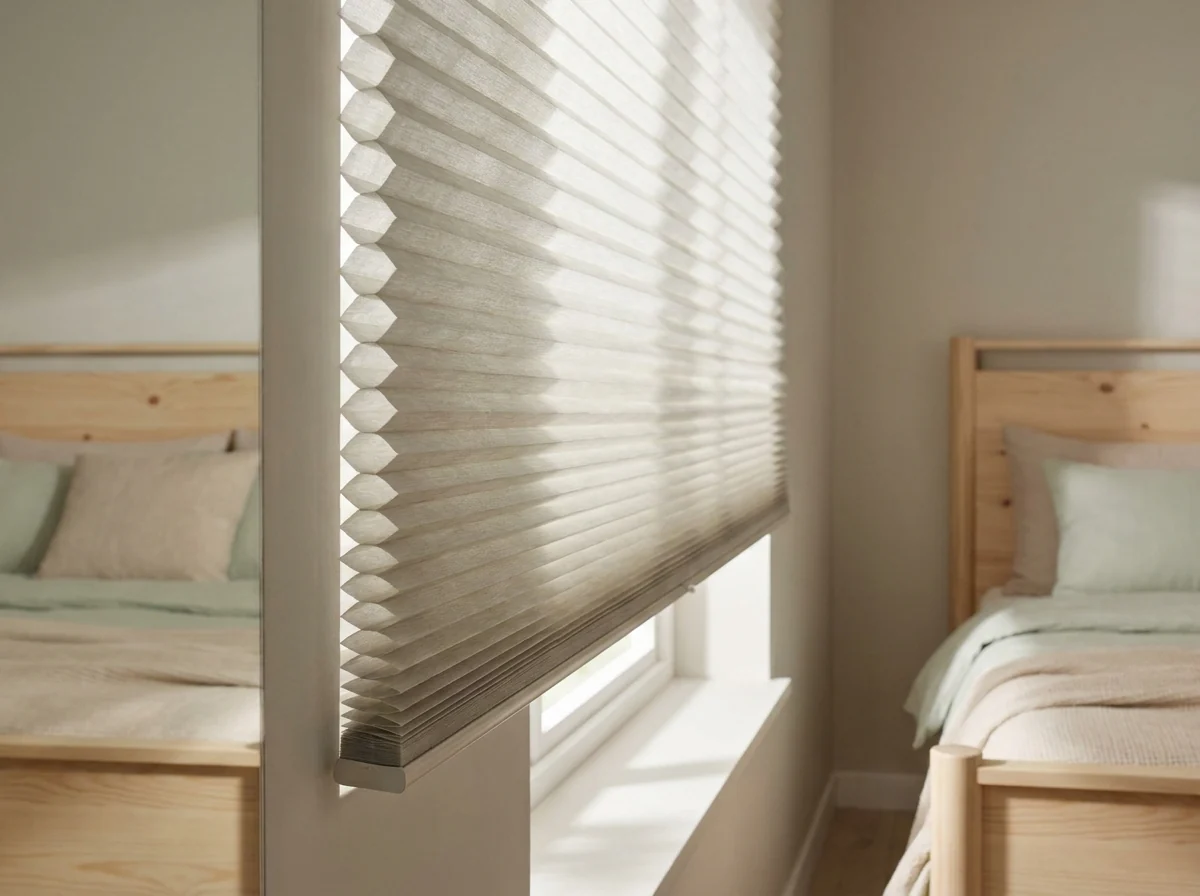
Honeycomb blinds trap a layer of air in their cells, so they take the edge off both a 28°C February afternoon and a cold June morning better than any flat fabric — the strongest insulator in the range, and available with a blockout cell for a dark bedroom. In a dry, decently ventilated bedroom, this is the comfort pick.
Where it’s the wrong choice: in a poorly ventilated, south-facing wet-winter room a fabric cell can hold onto damp and eventually mildew. That specific room wants the aluminium venetian below, not honeycomb — comfort matters less than not growing mould.
Damp south rooms, bathrooms, low-airflow kitchens
Aluminium venetians where a fabric blind would suffer
Durbanville’s wet winters and least-ventilated south rooms are where fabric struggles. Aluminium venetian slats wipe clean, shrug off steam and condensation, and tilt for light and privacy — the honest, durable answer in a bathroom or a shaded south room where a cellular or roller blind would slowly take on moisture.
The trade-off: aluminium insulates far less than honeycomb and can look more utilitarian. In a dry living room or bedroom you’d lose comfort choosing it — so it’s a room-by-room call, not a whole-house one.
The stoep · overhead summer shade
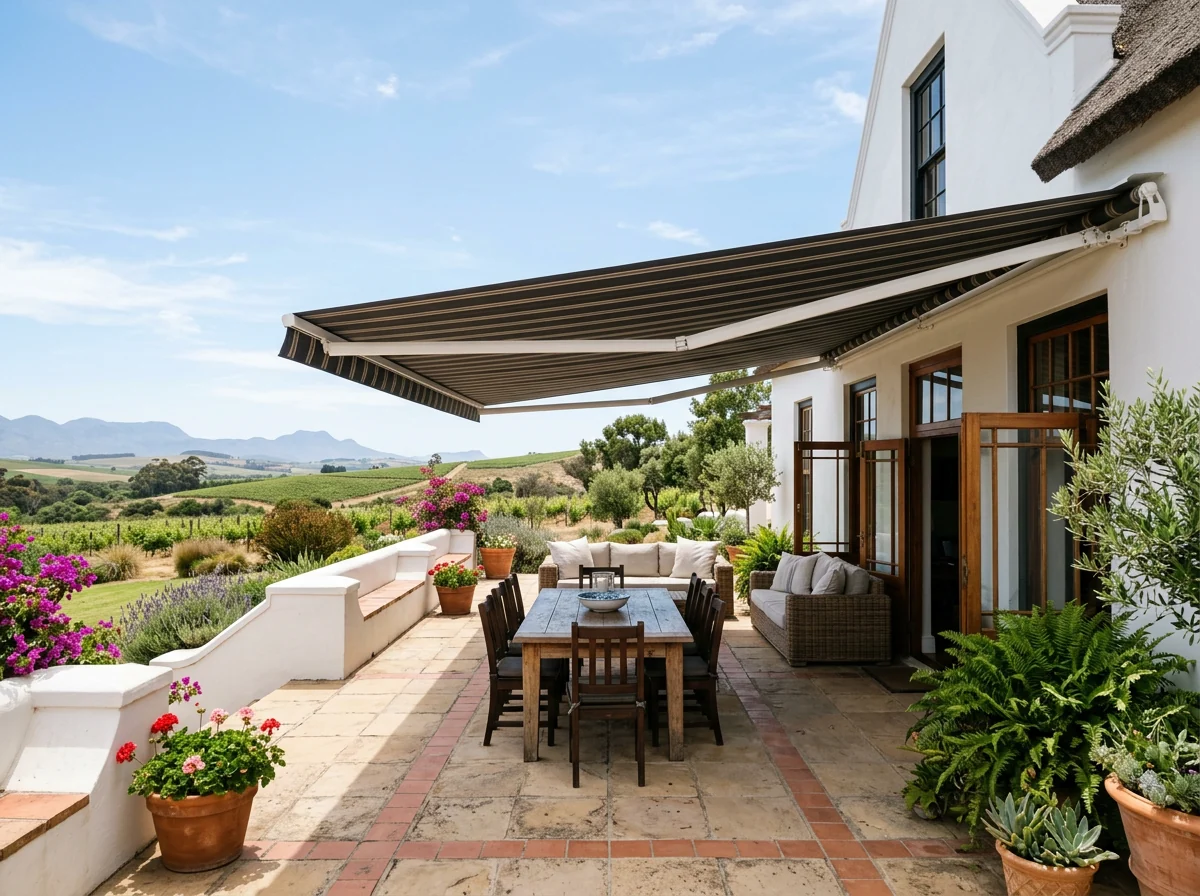
A folding-arm awning for the stoep lunch
For a wide stoep built for a Sunday lunch, a retractable folding-arm awning throws overhead shade across the whole table and rolls away when you want the winter sun back. On a north or west stoep it’s the difference between using the space at midday in February and abandoning it.
Honest limits: an awning shades from above, so it does little against low, side-on west sun or against the south-easter — and it must go up with a wind sensor that auto-retracts, or that same wind will wreck it. For wind and low sun you want the zip screen below; many stoeps end up with both.
The stoep · wind, low sun & insects
Zip screens to close a stoep against the south-easter
The prevailing summer wind here is a strong south-easter, and a normal drop-blind flaps and tears in it. A zip screen runs in zipped side channels so the fabric can’t flap — it seals the stoep against wind, low afternoon sun and insects, turning it into a usable room on a gusty Cape evening.
The trade-off: a zip screen drops vertically, so it’s not overhead shade — at high summer noon you’d still want the awning above it. Pick the zip screen for wind and the low western sun; pair it with an awning for midday overhead cover.
Wide, tall, view-facing estate glass
Motorisation on the big spans — often the only practical option
On the floor-to-ceiling glass going into estates like Graanendal and Clara Anna Fontein, a blind can run past 3 m of fabric — too big to hand-chain comfortably, and often out of arm’s reach entirely. A motor with a sun sensor can also drop the west blinds automatically at 16:00 before the room heats, and retract an awning when the wind sensor triggers. Battery motors suit a retrofit with no wiring; wired motors suit a new build.
Where it’s a luxury, not a need: on a small, reachable window motorisation is a nice-to-have you can skip. It earns its cost on the wide, high, or hard-to-reach glass — not on every opening in the house.
The honeycomb cell, seen side-on — the trapped air is what makes it the range’s best insulator.
Heritage cores & new estates — two different jobs
A Cape-Dutch cottage on Church Street and a new build in a lifestyle estate are barely the same brief.
Durbanville’s old core still carries genuine Cape-Dutch heritage — the 1850s Rust-en-Vrede complex, the Onze Molen windmill, and original Cape-Dutch houses along Church, Gladstone, Main, Oxford, Queen and Scher Streets. Those homes have gables, deep stoeps, small-pane sash and casement windows, and deep window reveals. The right treatment there usually sits inside the reveal so the period frame stays visible, and it has to respect the depth of the reveal and the way older windows open. It’s a careful, measured job, not an off-the-shelf one.
The newer lifestyle estates are the opposite brief: walls of view-facing glass where heat load is the whole problem and motorisation is often unavoidable. Several of these estates run architectural committees, so anything fitted to the outside of the home — external venetians, awnings, zip screens — may need its colour and profile signed off first. We’d rather flag that at the quote than have you unpick it later.
A stoep built for a long lunch — overhead awning for the midday sun, with a zip screen the honest partner for the south-easter.
What we’d still need to check on site
A guide gets you to the right product. Only a tape measure and a look at the actual wall gets you the right quote — here’s what a photo or an online tool can’t settle.
Exact reveal depth. Whether a blind can sit inside the reveal or has to face-mount depends on millimetres — and Durbanville’s deep Cape-Dutch reveals and modern plaster returns behave very differently. This decides how the blind looks and whether it clears the handles.
What’s behind the plaster. Face-brick, a timber lintel, an aluminium frame or a plasterboard bulkhead each need a different fixing. On a heavy motorised blind or an external device on a windy elevation, the substrate is a safety question, not a detail.
How exposed that specific stoep is. The south-easter hits one corner of a property far harder than another. Which awning or zip screen — and which wind sensor setting — depends on standing in that spot, not on a floor plan.
Motor power routing. For wide estate glass we need to see whether we can reach power for a wired motor or whether a rechargeable battery motor is the cleaner answer — that’s a look at the wall and the nearest point, on the day.
Any estate architectural sign-off. If you’re in an estate with a committee, we’ll confirm what external colours and profiles are allowed before quoting, so nothing you order gets rejected on install.
Two honest ways forward
You’ve read the thinking — here are both routes, side by side.
Want a rough budget first? The ballpark tool below turns approximate sizes into a budget range by the next working day. Rather skip the measuring? Leave it — our consultant measures every window for free and you’ll get exact per-window pricing. Most people do the free measure; the ballpark is just there if you like a number first.
Pick your route below — a quick ballpark, or the free measure that gets it exactly right.
Your two ways forward
A ballpark in two minutes, or the free measure that gets it exact
Want a ballpark first? Pop in rough sizes and we’ll send a budget range by the next working day. Not sure how to measure? Leave it — our consultant measures for free and you’ll get exact per-window pricing.
Optional · about two minutes
Your ballpark
Rough sizes are fine — we’ll turn them into a budget range, not a fixed quote. Add a row per window; pick the product you read about above. Prefer paper? Print it and walk the house first.
Recommended · free, no obligation
Book your free expert measure
Not on the guide’s home turf yet?
See the full range and how it’s made and fitted, or jump straight to arranging your free in-home measure.
Climate, geography and heritage facts in this guide are drawn from the references below. Sun-angle figures are calculated from Durbanville’s latitude using standard solar geometry.